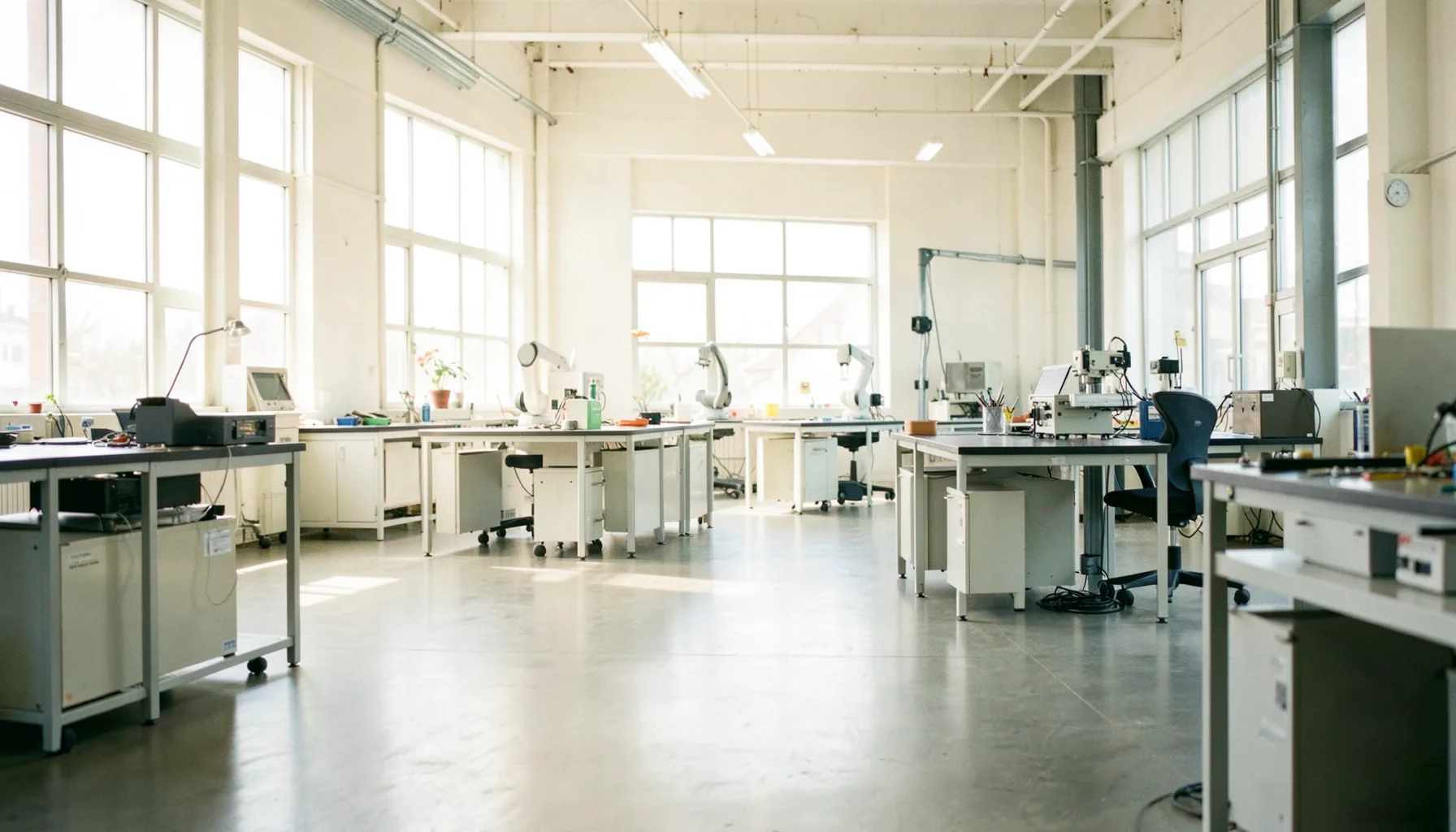
Confirming factory floor readiness for an industrial robot
The growing appetite for automation across Australian workshops and warehouses has put more pressure on facility managers to assess what sits beneath the wheels and feet of a six-axis arm or a gantry-mounted unit. Before a single component is crated up and shipped to a loading dock in Sydney or Melbourne, the slab itself has to be ready to carry, guide, and protect the equipment day after day.
Many small and medium-sized manufacturers on the eastern seaboard are retrofitting older brick-and-tile buildings or repurposed sheds that were never designed with robotic payloads in mind. The result is a recurring set of headaches: cracked toppings, oily patches, cable trip hazards, and robots that drift out of calibration because the floor moves underneath them. Addressing these issues up front protects both the capital investment and the people walking nearby.
This walkthrough outlines the practical checks that operations managers can run with their maintenance crew, an engineer, and a building surveyor. Each step is grounded in the way Australian facilities actually function, from the food plants of Wetherill Park to the fabrication shops in Geelong.
Structural load capacity and floor strength
The first question a structural engineer will ask is how heavy the robot is and how that mass is distributed. A standard welding cobot on a pedestal might weigh 250 kilograms, but a heavy-duty palletising arm with a 600 kilogram base plate transfers a very different load profile into the slab. The thickness of the concrete, the steel mesh density, and whether the floor is suspended or ground-bearing all shape the answer. In a heritage-listed facility in Brisbane's inner suburbs, for instance, you may find a 100-millimetre suspended slab that was rated for foot traffic and light trolleys only. Adding a robotic cell there without reinforcement risks cracking and deflections that show up weeks after commissioning.
For new builds on industrial estates around Campbellfield or Wacol, the slab is usually 150 to 200 millimetres thick with SL82 mesh, which suits most robotic applications. The safer route is to request the original engineering drawings and look for the characteristic yield strength, typically 32 MPa for Australian commercial slabs. If the documentation is missing, a ground-penetrating radar survey or core sample can confirm what is already in place before a layout is committed to.
Levelness, flatness, and vibration control
Floor flatness in the context of robotics is measured against standards such as ACI 117 or the local AS 3610 framework, with values expressed as F-numbers. A reach of two metres or more demands floor tolerances tighter than what is acceptable for forklifts, because tiny tilts compound across the arm's length. The base frame will flex, encoder readings drift, and repeatability numbers quietly get worse. Aim for a flatness floor zone around the robot base of at least ±2 millimetres over a 3-metre radius for light arms, and tighter again for heavier units.
Vibration is a constant threat to precision in any cell that relies on accurate path following. Nearby stamping presses, rolling shutters, or busy access ramps can transmit tremors that confuse force-torque sensors and degrade weld quality. Decoupling the robot plinth from the surrounding slab with a vibration-isolation pad, or simply pouring an isolated pad footing, is a common remedy in plants near Adelaide's automotive corridor. The same approach keeps the cell stable when forklifts rumble past on the daily truck run.
Power supply, cabling, and electrical infrastructure
A robot controller, a vision system, a safety scanner, and a conveyor interface draw a mix of three-phase and single-phase power, plus compressed air and shielded data cabling. In older Australian plants, distribution boards often combine lighting and machinery circuits, which can create nuisance trips once a robot is added to the line. Best practice is to install a dedicated sub-board with RCD protection rated for the inrush currents of servo drives, all wired by a licensed electrician who can issue a Certificate of Compliance for Electrical Work.
Cable management matters as much as the wiring itself. Robot dress packs and umbilical loops need to swing freely without snagging on floor protrusions. Running the power and signal in separate trenches with mechanical segregation, and using drag chains rated for millions of cycles, prevents the wear that brings a cell down during a busy production week. A clean floor layout also leaves room for future expansions, which is cheaper than ripping up a sealed epoxy coating two years down the track.
Floor markings, safety zones, and pedestrian pathways
Safe Work Australia and the model WHS laws require employers to clearly delineate areas where moving machinery operates. Painted yellow-and-black hatched zones around a robotic cell, light curtains at access points, and floor-anchored bollards are standard features on factory floors in Dandenong and Villawood. The markings also serve a practical purpose: they tell operators where dropped parts can be retrieved safely and where the teach pendant can be used without stepping into the envelope of motion.
Beyond compliance, good signage reduces friction with the workforce. Australian operators are accustomed to quick visual cues, and a well-marked floor lets a new starter understand the safe path through a cell within minutes. Adding high-visibility walkways that guide people away from the work envelope also limits the number of nuisance stops triggered by a passing shoulder, which keeps throughput up across a shift.
Space planning, reach envelopes, and end-of-arm tooling
A common mistake is to install the robot first and plan the cell layout around it, when the smarter sequence is to confirm reach, footprint, and tool weight before the slab is even patched. Most manufacturers publish detailed CAD models showing the swept volume in every joint configuration, and importing these into your facility drawing will reveal pinch points, conveyor clashes, and overhanging ducts. In tight workshops around Marrickville or North Geelong, where ceiling height can be a constraint, folding-arm or ceiling-mounted units often unlock floor space that would otherwise be unusable.
The end-effector deserves equal attention. Grippers, weld torches, and vacuum heads change the effective payload and the inertia at the wrist, which in turn alters the structural demands on the pedestal. Allowing a margin of at least 20 percent above the calculated peak load gives the arm headroom for product variation, a forgotten carton on a conveyor, or a heavier jig that arrives after a process change.
Maintenance access, floor coatings, and long-term adaptability
A robot that cannot be serviced will eventually be a robot that is bypassed. Maintenance bays need clear floor access of around one metre on the service side of the controller cabinet, plus enough overhead clearance to swap a wrist motor with a hoist. Floor coatings play a dual role: a heavy-duty epoxy with anti-slip aggregate protects the slab from oil and coolant spills, while a static-dissipative topcoat in electronics or food plants prevents dust attraction that fouls linear rails.
Plan for change. A facility in Perth that installs a cobot for palletising today may need to redeploy the same arm to a kitting bench in eighteen months. Keeping a generous buffer zone around each cell, and avoiding permanent fixings embedded into the slab, makes those moves faster and cheaper. The next stage of factory digital transformation often brings connected sensors and shared data, which is why teams are already reviewing what supply chain tracking workshop-preview-introduction-to-block-chain-for-supply-chain-tracking sessions cover for the year ahead.
If your team is ready to take the next step, the Shinagawa program offers guidance on supplier vetting, subsidy applications, and on-site readiness assessments tailored to Australian conditions. Reach out through the contact the program team page to book a walkthrough of your facility and a tailored action plan.