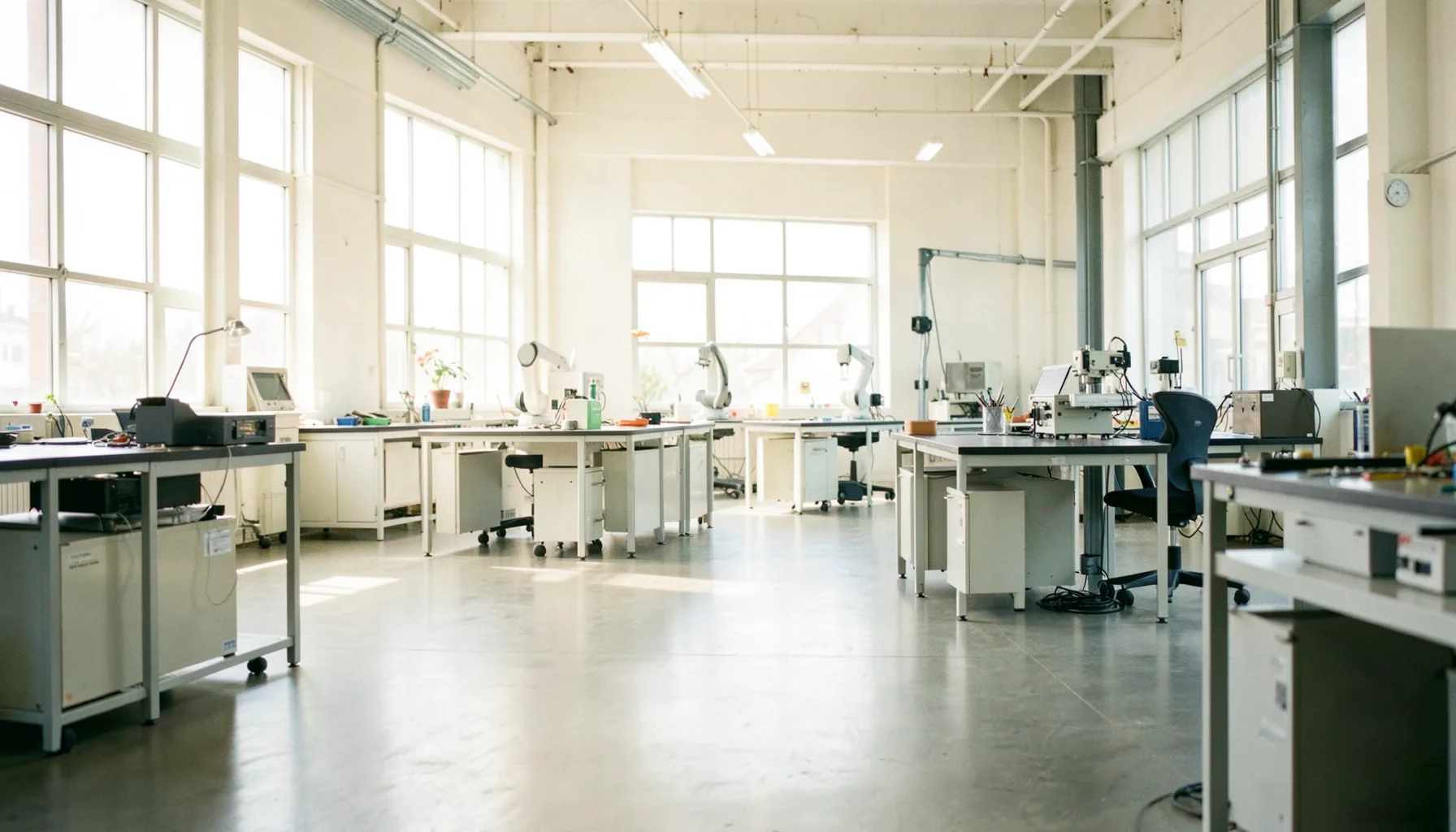
Simulating a robot cell for free before committing to hardware
A small electronics workshop in Brunswick might spend weeks choosing the right collaborative robot arm, only to discover the reach doesn't clear an existing conveyor. A Brisbane 3D printer operator could find a shortlisted unit clashes with the ventilation hood above the bench. Such scenarios play out across Australian manufacturing floors, from food packaging in Adelaide to precision machining in Perth.
The good news is that none of these problems require a purchased robot to surface. Free and open-source simulation tools let operators build, test, and refine a virtual robot cell on a laptop before any order form is signed. For Shinagawa-supported workshops, the first mistake becomes a learning moment rather than a sunk cost.
Hardware capital expenditure in Australia has climbed steadily, with average industrial robot prices now above A$80,000 once integration, guarding, and end-of-arm tooling are included. Free simulation software offers a low-risk way to evaluate kinematics, footprint, and throughput before any money changes hands, bridging office planning and factory floor reality.
For small and medium-sized businesses in Shinagawa's partner network, simulation is now considered a standard early step. A useful walkthrough of this approach can be seen in a small-parts assembly case study published by the program, showing how a local importer tested a layout virtually before buying.
Why a virtual robot cell pays off before buying
A robot cell includes the worktable, fixtures, infeed conveyors, safety scanners, operator stations, and the human-robot interface that ties everything together. Without a holistic view, a team can optimise the robot's reach while forgetting that a pallet jack needs to pass through the same aisle. Free simulation software renders the cell in three dimensions and calculates cycle time and collision events in real time.
For Australian manufacturers, the value is amplified by geography. Spare parts shipments from Sydney to Perth take a week, and integrators cluster in Melbourne and Brisbane. Catching a configuration problem in simulation removes the urgency of a long phone call, a couriered bracket, and idle shifts.
Return on investment calculations also become more honest. A 2D spreadsheet cannot show that a SCARA arm mounted on the wrong side of a conveyor adds three seconds to every cycle, but a 3D simulation can show that visually and numerically, making it far easier to defend the capital request.
Modeling a small assembly cell step by step
The first move is to import a CAD model of the part, fixture, and any existing furniture. Most free tools accept STEP or IGES files, standard outputs from Australian engineering houses. Once imported, the operator drags the robot model from the library onto the station and uses the teach pendant simulation to sketch the path.
Cycle time is measured by playing the simulation forward at full speed. For a cell feeding a bottling line in a Hunter Valley winery, the simulation might show a six-axis arm completing a pick in 4.2 seconds under ideal conditions but 6.1 seconds once sensor delays are added. That delta is the difference between a sound investment and an underperforming one.
The final step is collision and reach verification. A reach study confirms the arm can service every pick point without singularities, while a collision check shows whether the wrist would clip the safety fence during a transfer move. Both checks are central to a defensible buying decision.
Comparing free simulation platforms
Several platforms offer credible free tiers or open-source builds that suit small and medium-sized operators. They differ in depth, supported robot libraries, and the steepness of the learning curve. The table below compares four of the most accessible options available to businesses evaluating their first cell.
| Tool | License Type | Strength | Best For | Notable Limitation |
|---|---|---|---|---|
| RoboDK | Free for non-commercial use; educational licence | Huge library of post-processor robot models | Quick layout work without writing code | Offline-only station files, paid add-ons for some features |
| CoppeliaSim | Free educational edition | Flexible scene scripting, physics built in | Custom cells, vision testing, prototyping | Less direct link to specific brand controllers |
| Gazebo | Open source | Tight integration with ROS, strong physics | Roboticists comfortable with Linux | Steep curve, limited built-in factory asset library |
| Visual Components | Educational licence | Rich factory component catalogue | Discrete-event simulation of production lines | Export limits on the free version |
For most small businesses without a dedicated software engineer, RoboDK is the lowest-friction starting point. It supports most major robot brands sold locally and works on a standard Windows laptop, useful for managers in Geelong or Launceston. Python users often prefer CoppeliaSim for vision testing, while research teams in Canberra favour Gazebo for its ROS compatibility.
Limitations of free simulation platforms
Free tools rarely model the real-world signal behaviour of a production line, especially when vision systems, conveyor encoders, and PLC handshakes are involved. A simulation might show a 100-millisecond pick, but the actual line could suffer 800 milliseconds of latency from a network scan, so operators should treat simulation results as a floor rather than a ceiling.
Licensing also matters. Some free editions are restricted to non-commercial use, which means a contract packer in Melbourne using the software to win a client pitch could be in breach. Check the terms, and consider switching to an educational or small-business licence before client-facing work begins.
The last limitation is human intuition. A simulation is only as good as the assumptions entered, and first-time modellers often forget floor flatness tolerance, conveyor belt sag, or shadows from poor lighting. These details surface during commissioning.
Turning simulation output into a buying decision
The real value of a virtual cell is the conversation it enables. When a manager in Wollongong can show a co-owner a video of the cell running at 92 percent efficiency with a given arm, the decision is no longer a leap of faith. It becomes a documented choice with measured trade-offs.
Simulation also helps identify which features matter. A premium arm with integrated vision might be technically superior but unnecessary if a fixed camera achieves the same result, and a free simulation environment can host both options side by side, something a sales call rarely allows.
The documents and videos produced during simulation also double as training material. New operators can review the planned motion path, the expected cycle time, and the safe zones before the hardware arrives, shortening the commissioning window, which is one of the hidden cost lines in any automation project.
Practical recommendations for small businesses
A few habits tend to separate successful pilot cells from stalled ones. Once the simulation runs cleanly, the next question is how to turn that practice into a repeatable process the wider team can follow.
Drawing on Shinagawa program workshops and feedback from Australian manufacturers, these points have proven useful across food processing, light fabrication, and electronics assembly.
- Start with a narrow task such as a pick-and-place or a screw-driving station, then scale up only after the first cell has run for a full quarter.
- Use metric-native CAD models from the outset, since most Australian suppliers and integrators work in millimetres and switching late introduces avoidable errors.
- Record a one-minute video of every simulation run; these clips make it easier to brief stakeholders in Sydney, Adelaide, or regional offices without reinstalling software on every machine.
- Validate the cycle time against a manual stopwatch test on the real bench before approving the purchase order, since unaccounted loading time is the most common source of optimism.
- Reserve a contingency line of at least 12 percent of the hardware budget for guarding, integration, and the small surprises that always appear during commissioning.
If your business is exploring automation, the Shinagawa program runs monthly simulation workshops in the ward and connects local operators with vetted software partners. Contact the program to book a consultation and request the template. The next step toward a productive cell is often a free download, not a purchase order.